Zapier alternatives, ranked by what you actually automate
The best Zapier alternative depends on the work you're automating. Here's the honest list, ranked by use case, plus the category nobody puts on it.
 CollinFounder, Browzey6 min read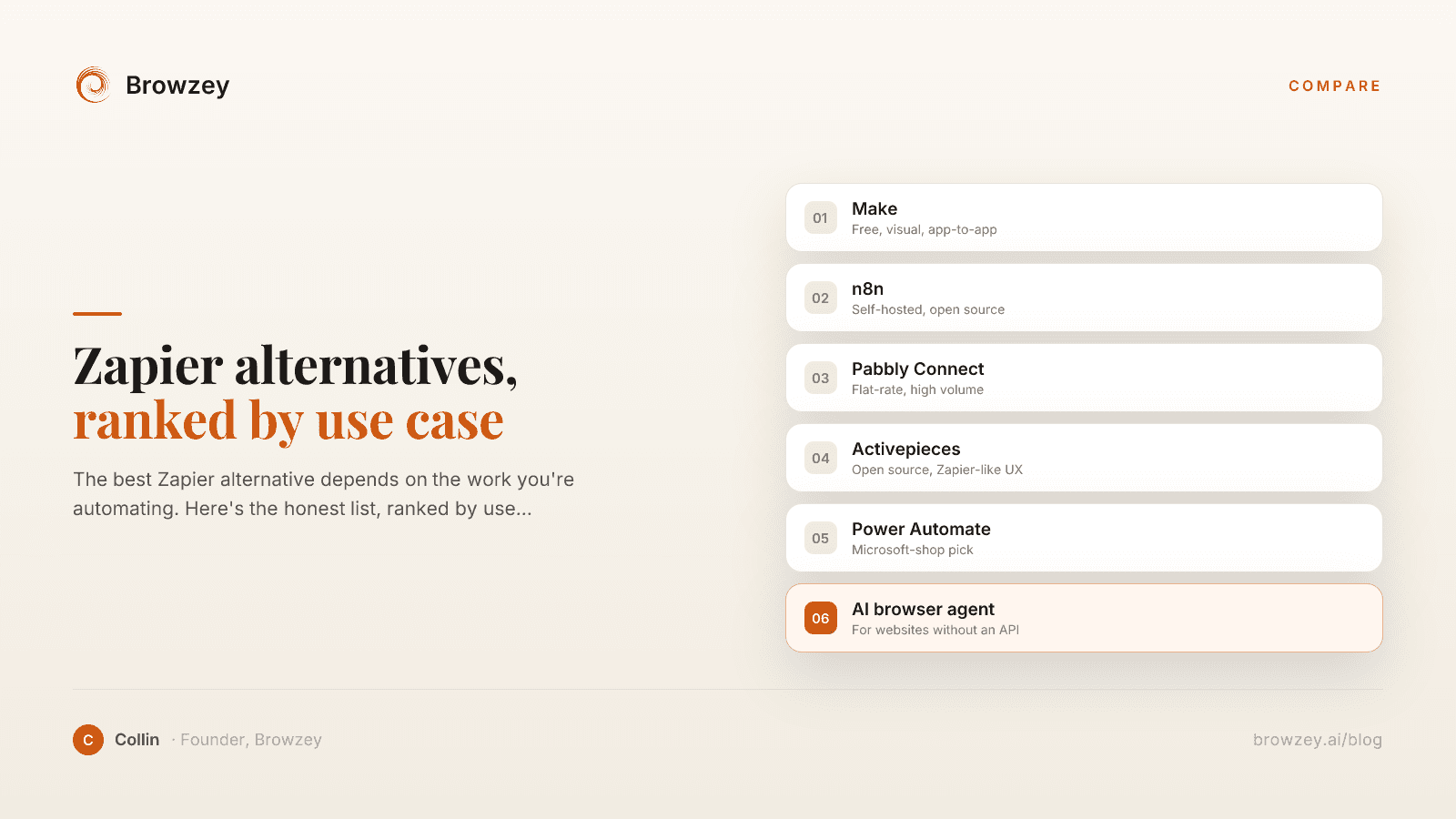
On this page
- Why I went looking for a Zapier alternative
- What a Zapier alternative is supposed to do
- The five honest direct alternatives
- 1. Make (the strongest free pick)
- 2. n8n (the self-hosted pick)
- 3. Pabbly Connect (the cheap pick)
- 4. Activepieces (the open-source pick that's actually usable)
- 5. Microsoft Power Automate (the Microsoft-shop pick)
- What none of those will do
- How to pick, fast
Why I went looking for a Zapier alternative
I'd been on Zapier for a couple of years, doing the boring middle-of-the-stack work it was built for. Slack-to-Sheets and Stripe-to-Notion, the obvious connectors. Worked fine, slowly got expensive. So I went looking for a Zapier alternative.
Then I needed to do something Zapier couldn't. Pull a list off a directory site that didn't have an API. Then a thing that involved logging into a portal. Then a task that required filling out a form on a vendor's site every morning. Zapier just shrugged. It wasn't built for any of that, and the half-dozen "Zapier alternatives" I tried weren't either.
That's the part the comparison posts miss. They list the same five or six tools and rank them on pricing and step count, and they're all aimed at the same job Zapier is aimed at. None of them help when the work happens on the web instead of between APIs.
Here's the honest list in two parts. First the direct alternatives, ranked by who they actually fit. Then the category nobody mentions.
What a Zapier alternative is supposed to do
Zapier is plumbing between SaaS apps. App A has an API, app B has an API, Zapier ferries data between them when a trigger fires. A new lead in HubSpot creates a row in Sheets. A new row in Sheets posts to Slack. That's the genre.
Most "Zapier alternatives" are the same genre with different trade-offs. Cheaper, smarter logic, self-hostable, prettier visual builder. None of them break out of the "A's API talks to B's API" frame.
If your work fits that frame, the list below is straightforward. If it doesn't, hold tight. I'll get to it.
The five honest direct alternatives
1. Make (the strongest free pick)
Make is what I'd reach for first if Zapier got too expensive. The free tier gives you 1,000 operations a month across unlimited active scenarios. The visual builder handles branching and error handlers without code. The pricing scales better than Zapier as you grow.
The catch: the visual editor is more powerful and therefore more confusing on day one. Plan an hour to feel comfortable, not five minutes.
Best for: visual app-to-app workflows where Zapier's pricing tipped over.
2. n8n (the self-hosted pick)
n8n is the one most engineers I know switched to. It's open source, you can self-host it for free, and the editor is a flowchart-style canvas with full code escape hatches. If your data shouldn't leave your servers, this is the answer.
The catch: setting up and maintaining the host is real work. The cloud version exists if you want to skip that, but then you've just bought a more flexible Zapier.
Best for: technical teams that want control over data and infrastructure.
3. Pabbly Connect (the cheap pick)
Pabbly Connect is flat-rate priced. No per-task multipliers, no surprise overages. For high-volume workflows where Zapier's per-task pricing hurts, this is usually the cheapest option I've seen.
The catch: smaller library of integrations than Zapier or Make. If the app you need isn't on the list, that's the end of the line.
Best for: cost-conscious teams running predictable high-volume work.
4. Activepieces (the open-source pick that's actually usable)
Activepieces sits between Make and n8n. Open source, drag-and-drop builder, about 400+ integrations, and a generous free cloud tier. The UX is the closest to Zapier of anything I tried.
The catch: a smaller community than n8n. Bugs and missing connectors take longer to find help on.
Best for: teams who want open source without n8n's setup tax.
5. Microsoft Power Automate (the Microsoft-shop pick)
Power Automate is the right pick only if you're already in the Microsoft world. SharePoint, Dynamics, Outlook, and Teams plug into it better than they plug into anything else, and it ships with desktop RPA for the legacy stuff.
The catch: outside the Microsoft stack the experience gets clunkier. Don't pick it just because it's bundled with your 365 plan.
Best for: orgs already running heavily on Microsoft.
What none of those will do
Now the part the comparison posts skip.
Every one of the tools above only works when both ends of the workflow have an API. If you want to read data off a website that doesn't, fill out a web form a vendor never built an API for, or log into a portal and pull a number off a dashboard, you're stuck. You can build a Zapier alternative for connecting your CRM to your invoicing tool. You can't build one for "go log into my supplier's portal every Monday and grab the delivery schedule."
That's most of the work I actually wanted automated. Stuff that lives inside the browser, on sites that were never designed to talk to other software. Lead lists off a directory. Numbers from a state filing site. A form on a vendor's checkout page that has no API at all. None of it has an integration. All of it eats hours.
The category that handles that work isn't on the Zapier-alternatives lists because it's a different shape entirely. It's an AI browser agent: a tool that opens a real browser, reads the page the way you would, and does the typing for you.
This is the category Browzey lives in. We built it because we kept watching capable people lose hours to web work that no API could reach. Browzey requires no code. Anyone who can describe a task in a sentence can automate it, and the same workflow keeps working when a site's layout changes. The agent reads the live page the way you would and does the work in a real browser. A few common jobs are already done for you in our free tools if you'd rather not build anything at all.
If your automation is API-to-API, use Make or one of the four below it. If your automation is "make the website do the thing I do by hand," none of them fit, and we built Browzey for that case.
How to pick, fast
- App-to-app, you want free → Make.
- App-to-app, you can host → n8n.
- App-to-app, you want flat-rate cheap → Pabbly Connect.
- App-to-app, open source with a Zapier-like UX → Activepieces.
- You're a Microsoft shop → Power Automate.
- Your workflow runs on a website without an API → an AI browser agent.
The mistake I see most often is people who really need that last row trying to force the work into the first five. They wire up an integration that almost works, add a manual step to fill the gap, and end up maintaining a half-automated workflow forever. If the actual job is "drive a real browser," reach for the right tool category. There's a longer breakdown for non-technical founders if you want to see what that shift looks like.
FAQ
What is the best Zapier alternative in 2026?
For most teams, Make is the strongest direct replacement: free up to 1,000 operations a month, a visual builder that handles complex logic, and pricing that scales better than Zapier. For self-hosted setups, n8n. For Microsoft-heavy orgs, Power Automate.
Is there a free Zapier alternative?
Yes. Make's free tier gives you 1,000 operations a month on unlimited active scenarios. Activepieces' free cloud plan gives 1,000 tasks per month. n8n is free if you self-host it.
What is the cheapest Zapier alternative?
Pabbly Connect is usually the cheapest at high volumes because it uses flat-rate pricing instead of per-task charges. n8n is effectively free if you can host it yourself, but you trade money for setup time.
Is there an AI alternative to Zapier?
Yes, but it depends on what you mean. Some tools (like Gumloop or Lindy) add AI steps to traditional app-to-app workflows. For automating work on actual websites (no API required), an AI browser agent like Browzey is a different category that handles work Zapier was never built for.
Why would I switch from Zapier?
The common reasons are price (per-task billing adds up), step limits, lack of advanced logic, or hitting a workflow Zapier can't run. The fourth one is the biggest blind spot: Zapier and its direct alternatives only work between apps that have APIs, so anything on a website without one is out of reach.
Further reading
The Non-Technical Founder's Guide to Browser Automation in 2026
A non-technical founder's guide to automating competitor monitoring, lead research, and market intelligence with Browzey, Notion, and Slack — no code.
May 1, 2026
How to Automate Data Entry and Save Hours Every Week
Learn practical strategies to automate repetitive data entry tasks. Reduce errors, save time, and free yourself from manual web form work.
January 21, 2025
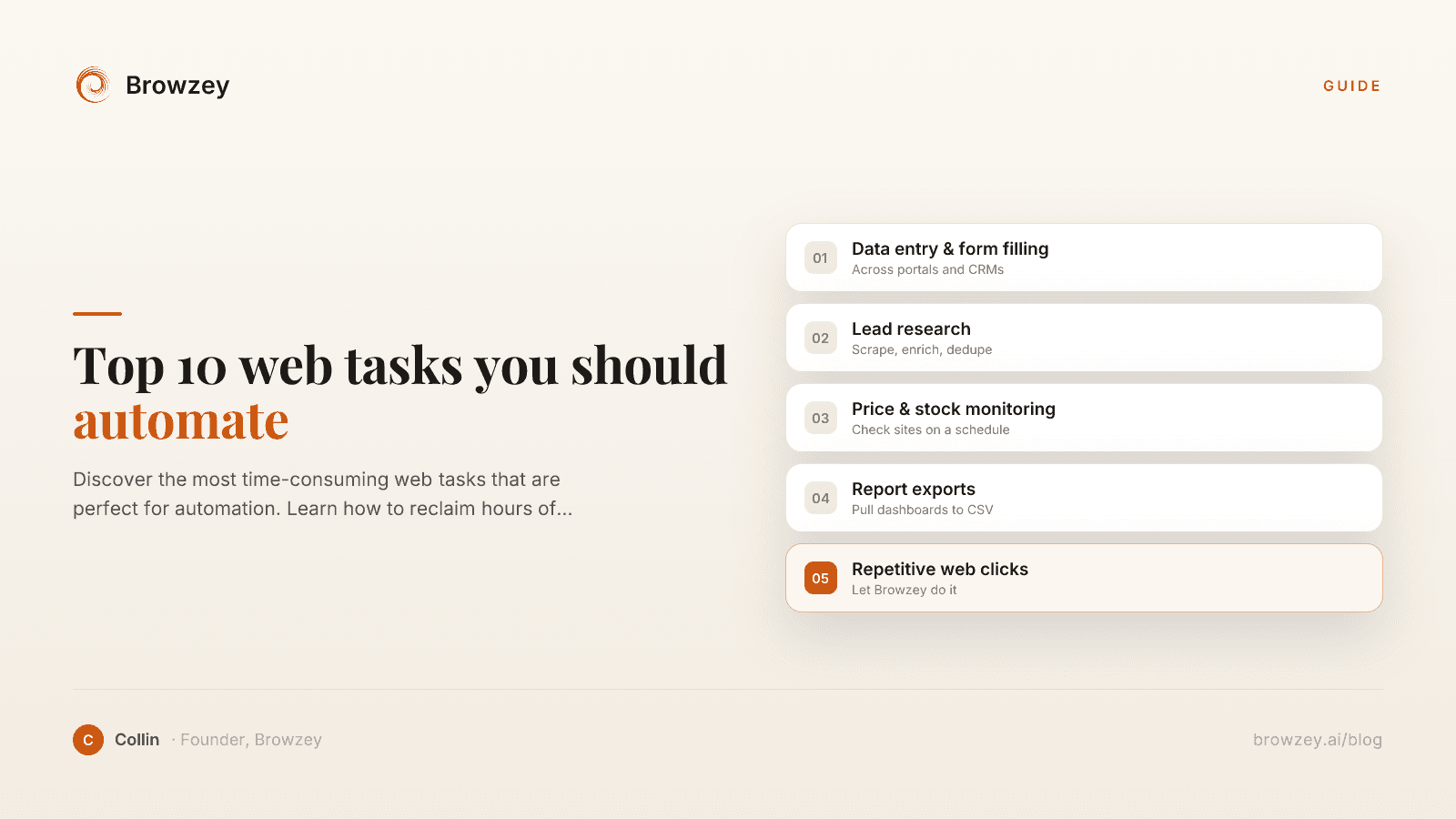
Top 10 Repetitive Web Tasks You Should Automate Today
Discover the most time-consuming web tasks that are perfect for automation. Learn how to reclaim hours of your week by automating these common workflows.
January 25, 2025
On this page
- Why I went looking for a Zapier alternative
- What a Zapier alternative is supposed to do
- The five honest direct alternatives
- 1. Make (the strongest free pick)
- 2. n8n (the self-hosted pick)
- 3. Pabbly Connect (the cheap pick)
- 4. Activepieces (the open-source pick that's actually usable)
- 5. Microsoft Power Automate (the Microsoft-shop pick)
- What none of those will do
- How to pick, fast